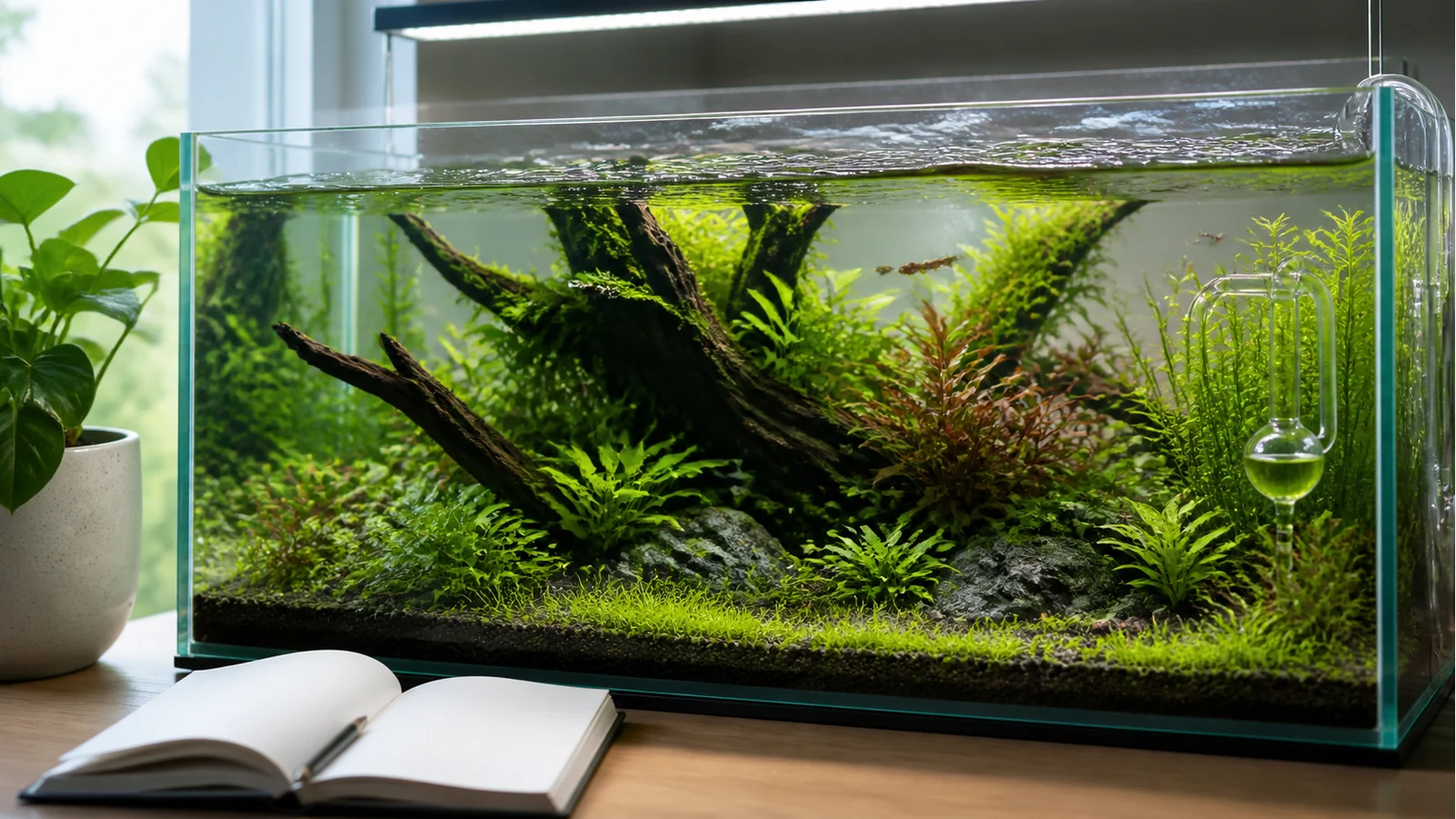
Surface Skimmer Without Losing Too Much CO2
Direct answer: you reduce CO2 disruption by using the lowest surface movement that clears the film, not by chasing a perfectly flat surface. In a planted aquarium, some surface exchange is useful, but excessive turbulence can waste CO2 and unsettle a stable routine. The practical method is to record the tank first, change one variable, and watch plants and livestock before touching the CO2 regulator.
The planted-tank trade-off is real. The Green Leaf Aquariums CO2 troubleshooting guide describes surface movement as important for oxygen exchange while warning that excessive agitation may increase CO2 degassing and reduce stability. That does not mean "never skim the surface". It means tune the surface gently and prove the result in your own aquarium.
CO2 trade-off
A surface skimmer does not automatically remove too much CO2, but any setting that creates unnecessary turbulence can increase gas exchange. Start with the lowest setting that clears the film, then watch livestock behaviour and plant response before making another change.
What to record before changing flow
Before adding or adjusting a surface skimmer, write down the current photoperiod, CO2 start and stop times, drop-checker colour if you use one, fish and shrimp behaviour, filter outlet direction, and when the surface film is worst. Take two photos from the same angle: one before lights come on and one near peak lighting. This gives you a baseline that is better than memory, especially when several tank variables tempt you at once.
Do not increase CO2 just because a skimmer has been installed. If fish move higher, breathe faster or avoid normal areas, livestock behaviour overrides the aquascape plan. The RSPCA guidance on fish health signs is a useful reminder that repeated surface gasping can signal oxygen or water-quality trouble, so the reader's first duty is the animal, not the photograph or contest image.
Seven-day lowest-effective-flow checklist
- Day 0: clean obvious plant trimmings and reduce overfeeding. Confirm the film is not a one-off maintenance issue.
- Day 1: install the skimmer at the lowest practical flow and a conservative height. Do not change CO2, fertiliser or lighting.
- Day 2: check whether the film is broken across the whole surface or only near the intake. Adjust position before increasing flow.
- Day 3: observe livestock during peak CO2. Normal feeding and calm swimming matter more than a perfectly polished surface.
- Day 4: inspect floating plants, moss fragments and recent trimmings. Add protection or reduce flow if material gathers at the comb.
- Day 5: compare photos. If the film is gone and livestock is normal, keep settings stable.
- Day 6-7: make one small adjustment only if the film remains. Avoid changing skimmer flow and CO2 at the same time.
How to judge the result
A successful result is not the strongest ripple you can create. It is the lowest setting that keeps the visible film from returning while fish, shrimp and plant response remain normal. If the drop checker, if used, looks broadly like its previous pattern, fish feed normally, and the surface is clear enough for light and viewing, hold the setting. Do not keep increasing flow for cosmetic perfection.
A mixed result needs patience. If the film is better but not gone, move the skimmer slightly or remove floating debris before raising flow. If the film disappears but livestock behaviour changes, reduce disturbance and review oxygen, CO2 and water-quality basics. If plants pearl less for one day, do not panic; look for a repeated pattern across several days. The purpose of the week is to avoid false conclusions from one evening.
A failed result is clear too. If the surface film remains at every comfortable setting, the cause may be feeding, inadequate whole-tank circulation, excess organics or maintenance timing. If the only effective setting creates splashing, livestock stress or obvious CO2 instability, this is not the right operating point for that aquarium. Return to husbandry and flow planning rather than forcing the skimmer to solve every problem.
Alternatives to try first
If the film appears after heavy feeding, change feeding before buying. If one corner is dead, a small outlet adjustment may solve it. If the issue appears after trimming floating or stem plants, remove debris manually and wait. If the filter itself is due for maintenance, restore normal circulation first. A surface skimmer is most useful when those simpler corrections do not last.
Who should not add a skimmer yet
Do not add a skimmer if the tank is already showing CO2 stress, if fish gasp near peak injection, if shrimp are leaving planted areas, or if you cannot observe the tank during the first few days. Do not add one to compensate for poor circulation throughout the whole aquarium. Surface equipment can complement circulation; it should not hide a badly planned flow pattern.
Stop conditions
Stop the experiment if fish gasp, shrimp climb, plants or livestock are drawn into the intake, or water tests suggest a separate problem. Stop increasing surface movement if the film is already gone. Stop changing CO2 until you have several days of stable observations. If you bought online, GOV.UK's GOV.UK guidance on online returns is a useful baseline for understanding cancellation and return timing while you run a structured trial.
Conditional product fit
For a 100-150 litre aquascape, AquarSurfa's relevant supplied features are top flow adjustment, floating comb and a three-level bracket. Those features fit the lowest-effective-flow method because they let you tune surface movement without immediately moving the main filter outlet. The product is not relevant if you need a published flow curve, exact CO2 retention data or automated scheduling instructions; those claims are not in the supplied facts.
When this check is not enough
Do not use a surface skimmer as a standalone fix for poor filtration, unsafe livestock behaviour, ammonia, nitrite, disease or unsuitable tank setup.
When to stop and reassess
Stop and reassess when fish gasp at the surface, livestock could be pulled into the intake, electrical equipment is damaged, water level is unstable, or the tank problem affects animal welfare.