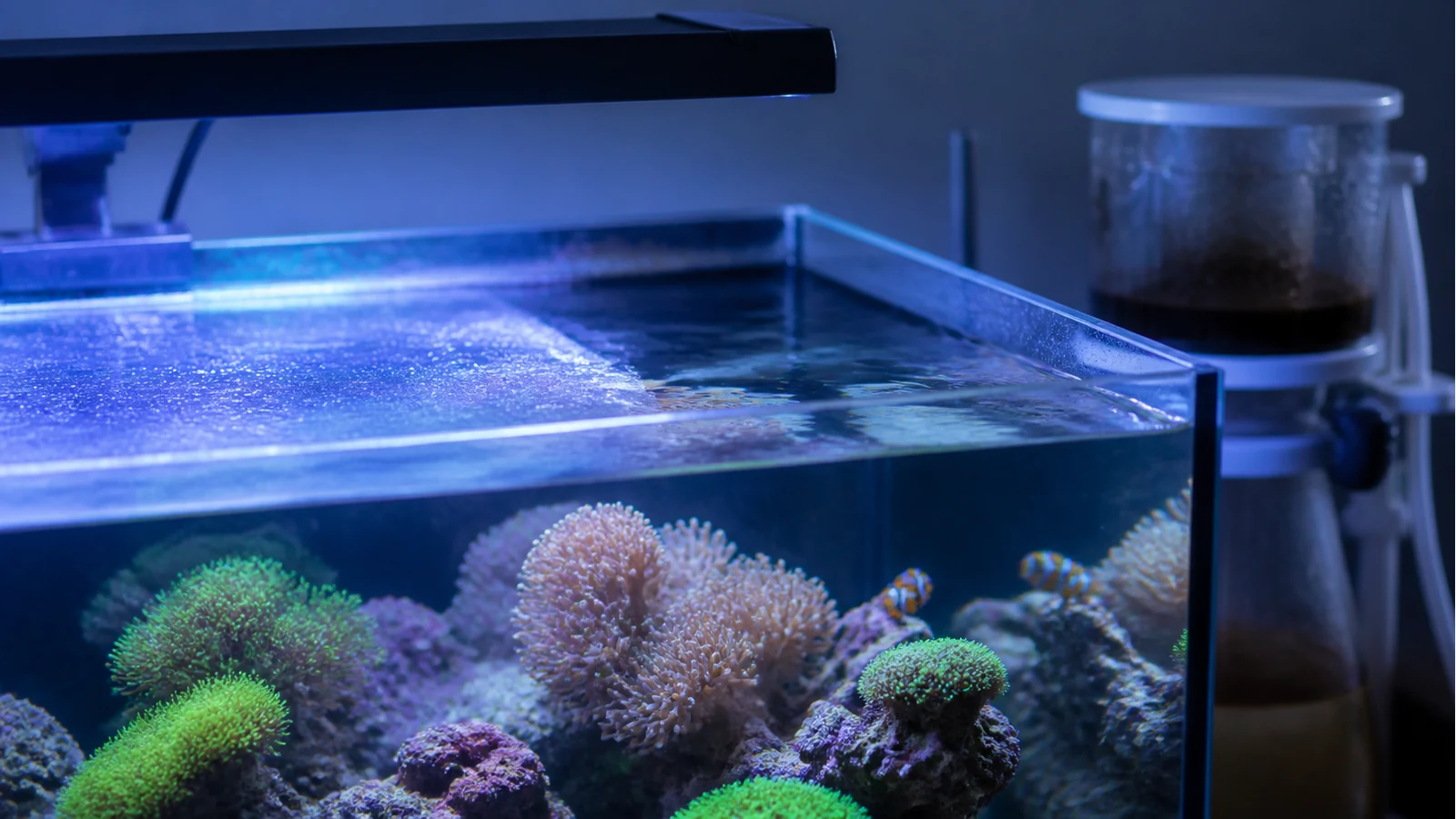
Surface Skimmer Vs Protein Skimmer Marine Tank
Direct answer: a surface skimmer and a protein skimmer do different jobs. A surface skimmer manages the top layer of water: film, dust, floating residue and the still patch that spoils gas exchange and viewing. A protein skimmer is mainly a marine filtration tool that mixes air and saltwater so organic compounds collect in foam and leave the system in a cup. If you buy one when you need the other, the tank may look tidier while the actual problem remains.
This confusion is common because both products use the word skimmer. In a small 100-150 litre marine or soft-coral tank, the decision should start with the symptom. Surface slick under blue light is a different problem from nutrient export, heavy feeding, dissolved organics or reef filtration planning. The Swell UK marine aquarium guide explicitly warns not to confuse protein skimmers with surface skimmers when explaining marine aquarium equipment.
Decision table
| What you see | Likely job | Better first action | Where a surface skimmer fits |
|---|---|---|---|
| Film or dust sitting on the water surface | Surface movement and top-layer removal | Check return direction, dead spots and waterline | Useful if the film returns and the tank size fits |
| Marine tank with heavy feeding or organic load | Organic export | Assess protein skimmer, water changes and stocking | Only a supplement for surface appearance |
| Fish gasping at the surface | Possible oxygen or water-quality issue | Test water and improve aeration urgently | Not the first response |
| No sump or cabinet space | Space-constrained equipment choice | Compare hang-on/internal options and maintenance access | Can help surface film without adding sump gear |
| Confusing search results for "aquarium skimmer" | Terminology problem | Match the product to the job, not the word | Choose only for surface-film management |
What a protein skimmer does
Protein skimmers belong mainly to the marine side of the hobby. The Practical Fishkeeping protein skimmer guide explains that protein skimmers mix air with water and use bubbles to remove protein-rich organic waste before it breaks down further. That is a filtration and nutrient-management role. It often involves a collection cup, airflow adjustment, maintenance space and sizing judgement based on tank volume and bioload.
A surface skimmer does not perform that same export job. It may improve the top layer and help surface exchange, but it will not collect dark skimmate from dissolved organics in the way a marine protein skimmer does. For a reef tank with nutrient problems, nuisance algae, heavy feeding or coral sensitivity, do not use a compact surface skimmer as a shortcut around marine filtration planning.
Three common marine scenarios
Scenario one: blue light shows a slick but tests are stable. This is the cleanest surface-skimmer case. The tank may already have suitable filtration, water-change rhythm and livestock behaviour, yet a thin film collects where return flow misses the surface. In that case, a surface skimmer can be tested as a display-polishing and surface-exchange accessory. Start with gentle flow because small marine tanks can look busy quickly.
Scenario two: nutrients are rising and coral response is poor. This is not a surface-skimmer decision. You may still dislike surface film, but the bigger job is export and husbandry: feeding level, mechanical filtration, water changes, protein skimmer sizing where appropriate, and maintenance access. Buying a surface skimmer first may make the tank look calmer while delaying the decision that actually affects dissolved waste.
Scenario three: there is no sump and very little cabinet space. Space limits can make a large protein skimmer unrealistic, but they do not change definitions. A compact surface skimmer can target surface film inside the display. It cannot create the collection-cup export of a protein skimmer. If you need both jobs, you need two compatible strategies, not one blurred purchase.
What goes wrong when the terms are mixed
The expensive mistake is not merely buying the wrong box. It is building the wrong expectation. A buyer who expects a surface skimmer to reduce dissolved organics may keep feeding and stocking as before, then wonder why algae or nutrient signs remain. A buyer who expects a protein skimmer to solve a local surface dead spot may add larger equipment while the slick still gathers in the display corner. Good comparison shopping protects attention: name the job, then compare products inside that job.
Maintenance also differs. Surface equipment asks whether the comb, sponge, waterline and small intake path stay clear. Protein skimmers ask whether foam production, air intake, cup cleaning and water depth are stable. Those routines overlap only in the broad sense that both are aquarium maintenance. They should not be treated as interchangeable chores.
Where a surface skimmer helps a small marine tank
A surface skimmer is most relevant when the visible problem is film at the air-water boundary and the rest of the system is already being managed. In a 100-150 litre marine tank without much spare cabinet space, a compact internal surface unit can be attractive because it targets the display surface rather than requiring a sump. Adjustable flow matters because small tanks can look messy if surface movement is too aggressive.
The supplied AquarSurfa facts support this narrow use: 100-150 litre positioning, floating comb, three height settings, top flow adjustment, internal sponge and an air-intake silencer. They do not support a claim that the unit replaces a protein skimmer, cures nutrients or has a published long-term saltwater test beyond the supplied corrosion-resistant shaft statement. Keep the claim as modest as the job.
Who should not buy a surface skimmer for this query
Do not buy one if your actual target is dissolved organic export, if your reef plan calls for a protein skimmer, if you need to manage high bioload, or if the tank is outside the stated size. Do not buy if a wavemaker or return adjustment can solve the surface film without creating noise or livestock risk. Do not buy if you cannot protect small invertebrates, fry or loose algae from the intake.
Stop conditions
Stop comparing surface and protein skimmers if fish are gasping, corals are retracting unusually, ammonia or nitrite is present, salinity has swung, or livestock has been caught against an intake. The RSPCA guidance on fish health signs treats continuous gasping at the surface as a possible oxygen or water-quality warning. That situation needs water testing and correction first.
Conditional next step
If your marine tank is in the 100-150 litre range, your water tests and livestock behaviour are normal, and the unresolved problem is simply a recurring surface slick, reviewing the AquarSurfa product page is reasonable. If the job is nutrient export or reef filtration, compare protein skimmers instead. The clean decision is to name the problem before naming the equipment.
When this check is not enough
Do not use a surface skimmer as a standalone fix for poor filtration, unsafe livestock behaviour, ammonia, nitrite, disease or unsuitable tank setup.
When to stop and reassess
Stop and reassess when fish gasp at the surface, livestock could be pulled into the intake, electrical equipment is damaged, water level is unstable, or the tank problem affects animal welfare.