Do I Need a Surface Skimmer for My Aquarium?
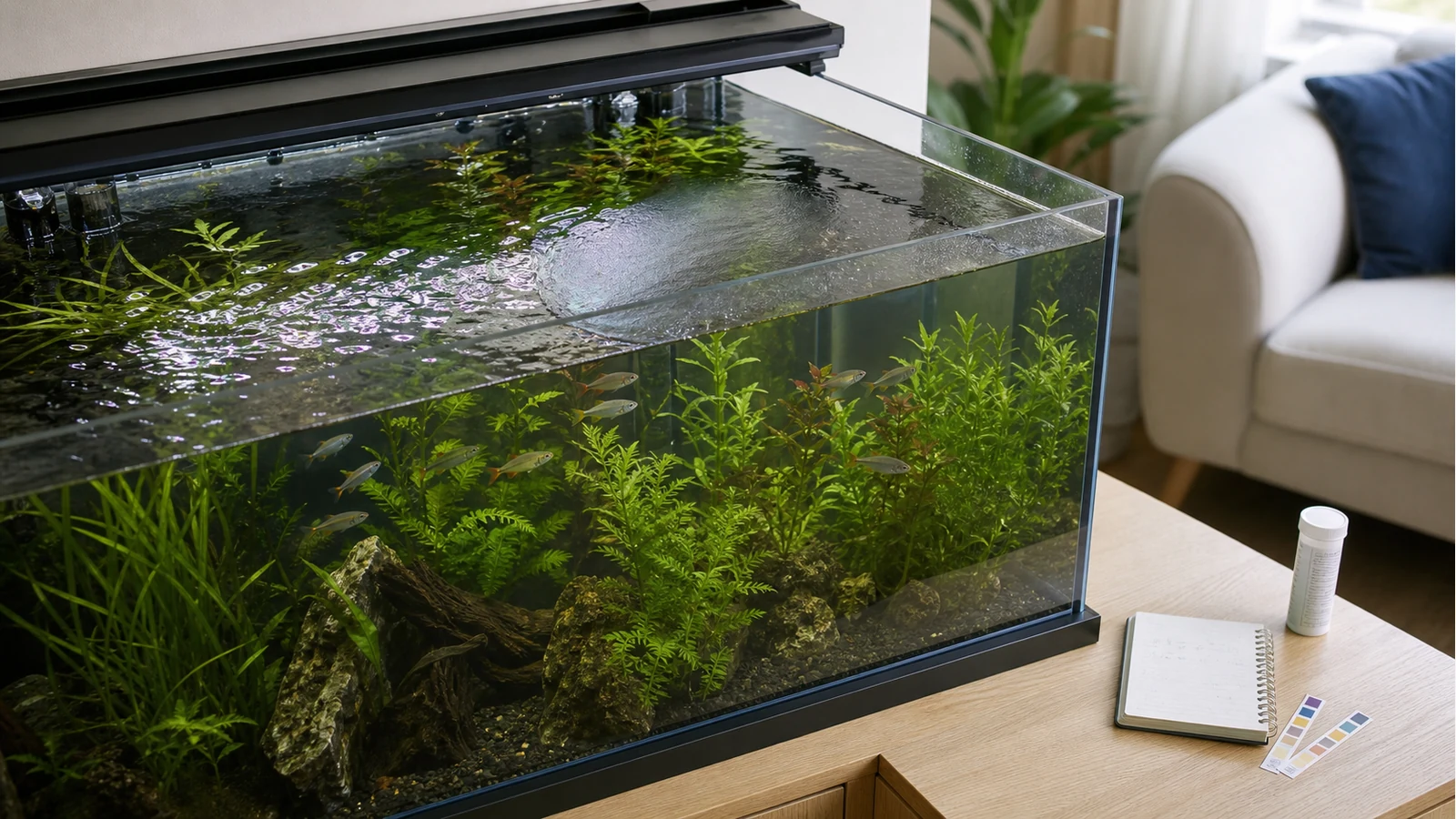
Direct answer: you may need a surface skimmer if the recurring problem is a film, dust line or still patch on the water surface after you have checked feeding, filter direction and basic water quality. You should not treat a surface skimmer as a cure for sick fish, low oxygen, ammonia, nitrite or a poorly cycled tank. In a 100-150 litre UK aquarium, the sensible order is: check the livestock, check the water, improve flow, then consider a dedicated surface skimmer if the surface remains the specific problem.
This matters because the same visible area, the top few millimetres of the tank, can show several different issues. A harmless-looking rainbow sheen may be food oil or biofilm. Fish gathering at the top may be normal for surface-feeding species, but repeated gulping is different. The RSPCA guidance on fish health signs says continuous gulping and gasping at the surface, except for species that naturally breathe at the surface, can indicate oxygen starvation or poor water quality. That is a welfare signal, not a shopping signal.
Start with the real job
A surface skimmer is a surface-management tool. It draws the top layer of water through a floating intake so film and light debris are moved into the unit rather than sitting under the aquarium light. That can improve the view from above, reduce dusty patches and help surface exchange. It does not replace the main filter, a test kit, water changes, quarantine practice or stocking judgement.
If your tank is new, recently overfed, heavily stocked or showing unusual fish behaviour, solve those basics first. The RSPCA advice on fish behaviour and overcrowding notes that fish behaviour and welfare are linked to water quality and crowding, so a tank can look clear while still being stressful for its inhabitants. The reader-friendly test is simple: if you are worried about the fish, do not start by comparing accessories. Start by checking the tank.
Diagnostic ladder for a 100-150 litre tank
- Look at the fish before the film. Are they breathing normally, feeding normally and swimming evenly? If they are repeatedly gasping, clamped, lethargic or behaving unlike themselves, treat that as urgent water-quality or health troubleshooting.
- Test the basics. Check ammonia, nitrite, nitrate, temperature and any species-specific requirements. A skimmer can make the surface look better while leaving the cause untouched.
- Review feeding. Oily food, excess flakes and uneaten food can contribute to surface residues. Feed less for a few days, remove obvious uneaten food and watch whether the film returns.
- Check dead spots. If the filter outlet moves only one corner, the opposite end can stay still. Try a modest outlet adjustment before buying, but avoid creating a waterfall if noise is a problem.
- Consider livestock and plants. Floating plants, fry, shrimp and fine trimmings need care around any intake. Begin with the lowest practical flow and observe the intake area.
- Trial a skimmer only when the remaining problem is surface film. That is where a compact adjustable surface skimmer has a clear role.
Who should not buy or upgrade yet
Do not buy yet if your tank is outside the product's stated size range, if your main filter is failing, if ammonia or nitrite is present, if fish are gasping, or if the surface problem appears only after obvious overfeeding. Do not buy if your goal is to remove dissolved organics from a marine reef in the way a protein skimmer does. Do not buy if you cannot place the unit safely below the waterline with a tidy cable route and enough clearance for maintenance.
There is also a budget point. If you are a first-time fishkeeper and do not yet own liquid test kits, dechlorinator, a reliable heater where needed, and basic cleaning tools, those are usually more important than a surface accessory. A clean-looking top layer is not a substitute for a stable aquarium.
Stop conditions
Stop shopping and act on welfare first if fish are repeatedly gasping at the surface, if several fish become lethargic at once, if you detect ammonia or nitrite, if temperature has drifted, or if a fish is trapped against any intake. Stop installation if the cable, plug or socket arrangement is unsafe, wet, damaged or likely to be pulled.
When a surface skimmer becomes reasonable
If the tank is stable, the fish are behaving normally, feeding has been corrected and the same still surface film returns, a surface skimmer becomes a reasonable next step. For AquarSurfa specifically, the supplied facts support a conditional fit for 100-150 litre tanks, with a floating comb, three height positions, top flow adjustment, internal sponge and cleaning brush. That combination is most relevant when you want to tune the surface gently rather than rebuild the whole filter layout.
For UK online buying, remember that a retailer's stated trial or free-return offer is separate from baseline distance-selling rights. GOV.UK explains the general rules for online returns in its GOV.UK guidance on online returns. Use any trial period as a structured test: photograph the film before installation, set the flow low, observe fish and plants, then decide whether the device solved the specific surface problem.
The practical decision is not "surface skimmer good or bad". It is whether your remaining problem is truly at the surface, whether your tank size and livestock suit the equipment, and whether you can maintain it calmly every week. If those answers are yes, a skimmer is a targeted tool. If any answer is no, fix the underlying aquarium issue first.
When this check is not enough
Do not use a surface skimmer as a standalone fix for poor filtration, unsafe livestock behaviour, ammonia, nitrite, disease or unsuitable tank setup.
When to stop and reassess
Stop and reassess when fish gasp at the surface, livestock could be pulled into the intake, electrical equipment is damaged, water level is unstable, or the tank problem affects animal welfare.